
Investing
The ADU Boom: Turn Your Backyard Into Income
By Jefri Liriano, Broker, Massachusetts & New Hampshire
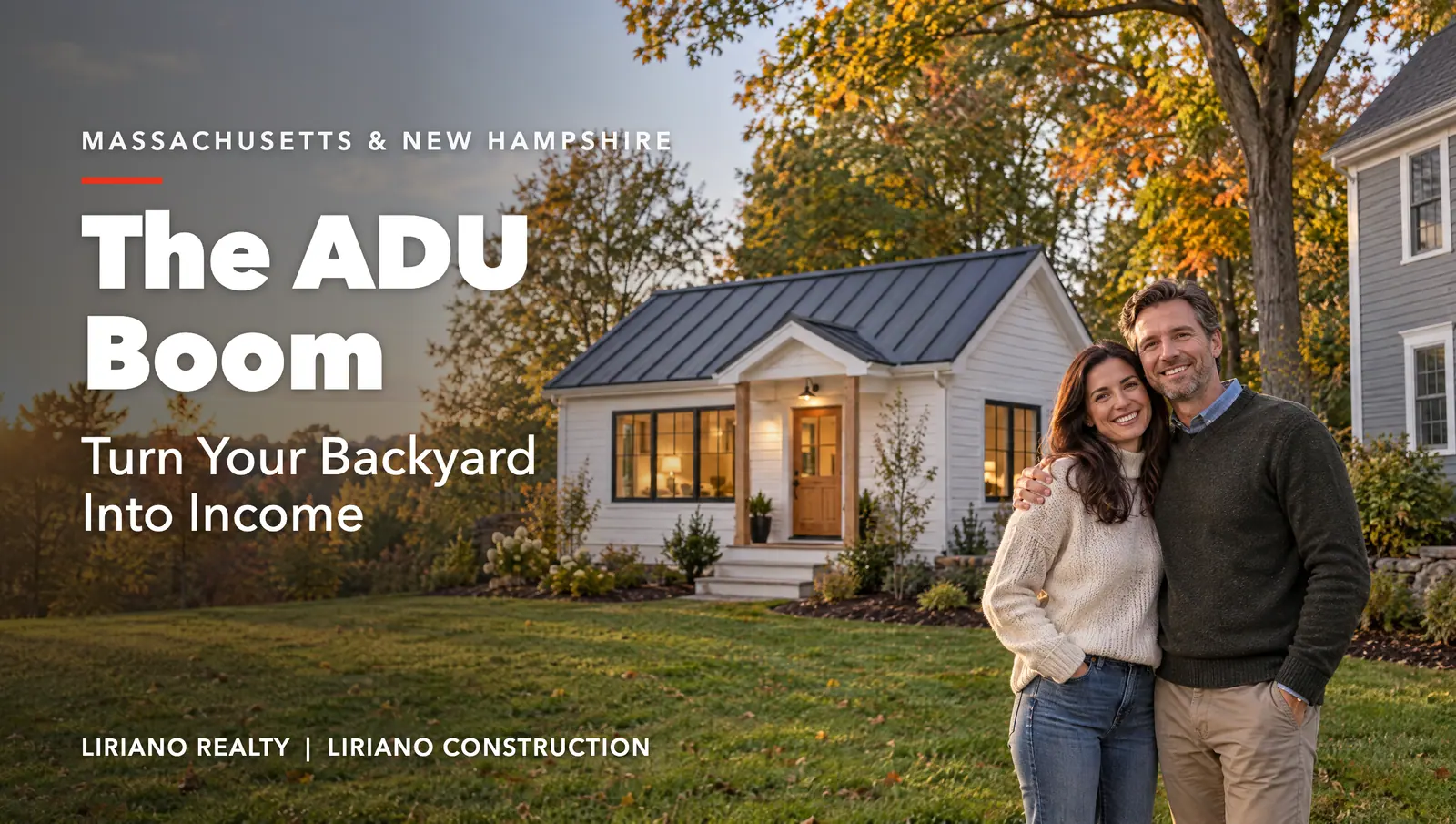
If you own a single-family home in Massachusetts or New Hampshire, you are holding something that was illegal or heavily restricted in most towns just a couple of years ago: the right to add a second, self-contained home on your own lot.
In 2026 that right is real, and homeowners are using it. Massachusetts towns approved 854 accessory dwelling units (ADUs) in the first six months of 2026, bringing the total to more than 2,000 since the start of 2025, according to the Governor's office. About 70% of Massachusetts communities have approved at least one.
That is a big shift in how land gets used. It is also a decision that costs real money, so it deserves a clear-eyed look. This guide covers what an ADU is, what the rules allow in each state, what it costs, whether it pays off, and how to take the first step.
What is an ADU?
An accessory dwelling unit is a complete, independent living space on the same lot as a main house. It has its own kitchen, bathroom, sleeping area and entrance. People call them in-law apartments, granny flats, backyard cottages or carriage houses. The legal name is ADU.
What makes it an ADU, and not just a bedroom you rent out, is that it can function as a separate home. A tenant or family member can live there with their own door, their own kitchen and their own privacy.
The four types of ADU
Not every ADU is a new building in the backyard. Understanding the types is the single best way to understand your options and your budget.
1. Interior conversion. You turn part of the existing house into a separate unit: a finished basement, an attic, or the space above an attached garage. This is usually the least expensive path because the walls, roof and foundation already exist.
2. Attached addition. You build a new section onto the side or back of the house with its own entrance. It shares at least one wall with the main home.
3. Garage or outbuilding conversion. A detached garage, barn or shed gets converted into living space. Cost depends heavily on the condition of the structure and what it needs to meet code.
4. New detached unit. A brand new small home in the backyard. It offers the most privacy and the most flexibility, and it is the most expensive because you are building everything from the ground up, including the utility connections.
What is allowed in Massachusetts
For years, whether you could build an ADU depended on your town, and in many towns the answer was no, or "maybe, after a long special permit process."
That changed with the Affordable Homes Act, signed in August 2024. Since February 2, 2025, one ADU is allowed by right in single-family zones across the state. By right means you do not need a special permit or a variance. If your project meets the basic standards, the town cannot use discretionary approval to block it.
The main rules, from the state's guidance on protected ADUs:
- Size. A protected ADU can be up to 900 square feet, or half the floor area of the main house, whichever is smaller.
- No owner-occupancy requirement. A town cannot require you to live in the main house or in the ADU.
- Parking. A town can require no more than one parking space for the unit. Within a half mile of certain transit stops, it cannot require parking at all.
- Separate entrance. The unit must be self-contained, with its own sleeping, cooking and sanitary facilities.
- Towns still control the basics. Setbacks, height limits, septic (Title 5), building code and short-term rental rules still apply.
- A second ADU is different. A second unit on the same lot needs a special permit, and only if your town chooses to allow it.
One more point matters if you already have an in-law apartment. A unit created before February 2, 2025 no longer has to follow an owner-occupancy rule, and if it meets the protected-ADU standards it can be treated as one.
What is allowed in New Hampshire
New Hampshire has required towns to allow ADUs for years under RSA 674:71 to 73. Every municipality must allow at least one ADU wherever single-family homes are permitted.
The big change came with HB 577, which took effect on July 1, 2025. It opened the door to detached ADUs, so a backyard cottage is now squarely on the table, not only an apartment inside or attached to the house. A 2026 follow-up law also eased the rules for older garages and outbuildings that no longer meet setback requirements, so more existing structures can be converted without a variance, as New Hampshire Public Radio reported.
Two cautions for New Hampshire homeowners:
- Details vary by town. New Hampshire is a local-control state, and towns still set many of the specifics, such as size limits. Check your municipality's zoning ordinance before you design anything.
- The laws are still moving. Several 2026 housing bills were debated in Concord, and some proposed to roll back parts of the 2025 gains. Confirm the current rules with your town planner before you spend money.
A related change worth knowing: HB 631 took effect July 1, 2026 and requires municipalities to allow multifamily housing in commercial zones. That is not an ADU rule, but it is another sign that New Hampshire is loosening its approach to housing.
What does an ADU actually cost?
This is where homeowners get surprised. A detached ADU is a new house, and it is priced like one, even when it is small.
Per square foot. Greater Boston builders are quoting roughly $250 to $400 per square foot, according to a 2026 Massachusetts homeowner's guide. At those rates a 750 square foot unit lands around $190,000 to $300,000. Other estimates put all-in totals for detached units between $225,000 and $450,000 or more, and local reporting shows some projects above that.
Costs before construction. Before a shovel hits the ground, expect to pay for:
- A site survey, often $7,000 to $10,000
- Design plans, often $1,500 to $5,000
- Energy modeling, often $1,200 to $1,500
- Permit fees, which vary by town
What moves the number. The same 600 square foot unit can cost very different amounts on different lots:
- Utilities. Running water, sewer, electric and gas to a backyard unit can be a major line item. If you are on septic, expect that to matter a lot.
- Site conditions. Ledge, slope, wetlands, drainage and difficult access all add cost.
- Foundation type. Slab, crawlspace and full foundation price very differently.
- Finish level. Kitchen, bath and flooring choices swing the total.
- Existing structure. Converting a solid basement or garage generally costs far less than starting from bare ground.
Treat any number in an article, including these, as a range to plan around and not a quote. The only way to know your cost is an itemized bid for your specific lot.
How to pay for it
Higher interest rates make borrowing more expensive than it was a year ago. The average 30-year mortgage rate was 7.40% in mid-October 2026, according to Freddie Mac. That makes it more important to understand your options. Common ways homeowners pay for an ADU include:
- Cash or savings. The simplest option if you have it.
- Home equity loan or HELOC. Borrowing against the equity in your current home.
- Cash-out refinance. It replaces your mortgage with a larger one, which may or may not make sense at today's rates if you hold a lower rate now.
- Construction or renovation loans. Some lenders offer products that account for the future value of the finished project.
- State programs. MassHousing has offered a dedicated ADU loan, and the Massachusetts Housing Partnership launched a program in December 2025 to help homeowners with ADU design, planning and financing. Program terms change, so confirm the current details directly with each agency.
Talk to a lender before you commit to a design. What you can borrow often shapes what you can build.
Will it raise your home's value?
Here is the honest answer: nobody has solid Massachusetts data yet. ADUs are too new here to have a track record, and many of the numbers you see online are marketing.
A local ADU builder put it plainly in the Boston Globe earlier this year: spending a quarter of a million dollars on a backyard unit does not automatically add a quarter of a million dollars to your home's value.
What we do know:
- Appraisals are the sticking point. Appraisers rely on comparable sales, and there are still few ADU sales to compare. Evidence from other cities suggests the problem eases as more ADU properties sell.
- Value depends on the specifics. Your town, your lot, the quality of the unit and the rent it can command all matter.
- Some ADUs pay for themselves. Others are worth it for reasons that never show up in an appraisal.
If anyone guarantees you a specific return on an ADU, be skeptical. A smarter approach is to ask an agent for a market analysis of your home both with and without the unit, and then compare that to the build cost.
What could you earn in rent?
Rent depends on your town, the unit size, the finish level and the season. A one-bedroom in Methuen rents differently than one in Lexington or Portsmouth, and a furnished unit near a university rents differently than an unfurnished one on a quiet street.
Rather than rely on a number from an article, ask for a rental analysis on your actual address using current comparable rents. Then run a simple test:
- Estimate the monthly rent.
- Subtract property tax changes, insurance, any utilities you cover, maintenance and a vacancy allowance.
- Compare what is left to your monthly cost of borrowing to build the unit.
If the numbers cover the loan with something to spare, the project is financially strong. If they do not, you may still choose to build for family reasons, but go in knowing the unit is a lifestyle decision and not an income engine.
One legal note: Massachusetts towns cannot unreasonably restrict renting an ADU, but they can regulate short-term rentals. If your plan is to list the unit on a short-term platform, check your town's rules first.
Who should build an ADU?
An ADU is not right for every homeowner. It tends to make the most sense in a few situations:
Multigenerational living. You want to house a parent, an adult child or a relative with independence and privacy, while staying close.
House hacking. You want a tenant to help cover your mortgage or build monthly income while you keep living in the main house.
Long-term rental income. You own for the long term, and steady rent from a second unit improves your return on the property.
Future flexibility. You want a space that can be a rental today, a home office tomorrow and a guest suite when family visits.
It may not make sense if you are planning to sell in the next year or two, your lot has serious site constraints, you cannot comfortably finance the build, or you do not want to be a landlord. A project that makes sense on a five or ten year view can be a poor choice on a one year view.
Mistakes to avoid
Homeowners run into the same problems again and again. Most of them are avoidable.
Skipping the feasibility step. Spending on design before confirming zoning, septic and utilities is how projects stall. Get the lot reviewed first.
Underestimating utilities and site work. The building is only part of the cost. Trenching, hookups and grading can surprise you.
Assuming the appraisal will match the build cost. Plan on the unit's value being uncertain, and make the decision on rent and personal use, not on a hoped-for appraisal bump.
Ignoring the tax and insurance side. A new dwelling can change your assessment and your coverage. Ask your insurer and your town assessor before you build.
Not checking the local rules. State law sets the floor, and towns still control setbacks, height and short-term rentals. Read your local bylaw or ordinance.
Going with the first bid. Get itemized bids from builders who have actually built ADUs, not only new homes or remodels.
Where to start: a simple five-step path
- Confirm what your town allows. Find your zoning bylaw or ordinance and read the ADU section, or call the planning department.
- Look at your lot. Septic or sewer, water, access, slope and setbacks decide what is practical.
- Define your goal. Rental income, family housing and resale value lead to different designs and budgets.
- Run the numbers. Estimate the construction cost, the financing and the expected rent, and compare scenarios.
- Get a feasibility review and real bids. Only an on-site look and itemized pricing can tell you what your project actually costs.
Frequently asked questions
Do I have to live on the property?
In Massachusetts, a town cannot require owner occupancy for a protected ADU. In New Hampshire, check your local ordinance, since the details vary by town.
Can I build more than one ADU?
In Massachusetts, a second ADU on the same lot needs a special permit, and only if your town allows it. New Hampshire's state law requires towns to allow at least one.
Will my property taxes go up?
They can. A new dwelling typically changes your assessed value. Ask your town assessor how an ADU would be treated.
Can I use it as a short-term rental?
Towns can regulate short-term rentals even where ADUs are allowed. Confirm your local rules before you plan around nightly rentals.
How long does it take?
It depends on the design, the permitting and the construction scope. An interior conversion generally moves faster than a new detached unit. Ask your builder for a timeline specific to your site.
Does an ADU change how I sell my house later?
It can make the property attractive to buyers who want rental income or multigenerational space, but added value is not guaranteed and appraisals are still catching up. Talk to an agent about how a unit would be marketed in your town.
How we can help
Most ADU decisions go sideways because the real estate side and the construction side never talk to each other. The builder prices the unit, the agent estimates the value, and nobody puts the two together.
We work both sides. Liriano Construction builds ADUs across Massachusetts and gives you a written quote for your lot after a free evaluation. Liriano Realty can tell you what the finished unit is likely to be worth to a buyer or a renter in your town, in Massachusetts or New Hampshire.
Thinking about an ADU? Get your free ADU evaluation, or book a free consultation to talk through the numbers first.
This article is general information, not legal, tax or financial advice. Zoning rules vary by town and are changing. Confirm the requirements with your local building department before you design or build.